We have all been there. You are trying to download a 4K movie before a flight, or maybe you are in the middle of a high-stakes online game, and suddenly—the dreaded buffering wheel appears. It is frustrating, right? Connectivity is the backbone of our digital lives, and Apple knows it. That is why the buzz surrounding the iPhone 17 Wi-Fi 7 speed boost is getting louder by the day.
While the iPhone 16 Pro gave us a taste of next-generation wireless technology, reports suggest that the 2025 iPhone 17 lineup is aiming to perfect it. Rumors indicate that Apple is planning a significant shift under the hood, potentially moving away from third-party suppliers to its own custom-built silicon.
This isn’t just about loading a webpage a millisecond faster. The iPhone 17 Wi-Fi 7 speed boost represents a fundamental shift in how our devices talk to the world around them. From augmented reality experiences to instant file transfers, we are looking at a future where lag is virtually non-existent.
In this deep dive, we are going to break down exactly what this technology means for you, separating the hype from the cold, hard data. Whether you are a tech enthusiast or just someone who wants their FaceTime calls to stop freezing, this is what you need to know.
Contents
- 1 The Technical Breakdown: What is Wi-Fi 7?
- 2 Apple’s Secret Weapon: The In-House Chip
- 3 Multi-Link Operation (MLO): The Real Game Changer
- 4 Why Speed Matters: Practical Applications
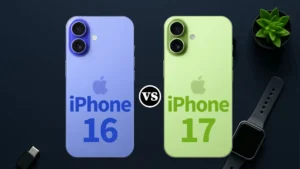
- 5 Comparing Generations: iPhone 16 vs. iPhone 17
- 6 The Router Requirement: A Hidden Cost?
- 7 Battery Life Implications
- 8 The Pro vs. Standard Debate
- 9 Security Improvements: WPA3
- 10 What the Analysts Are Saying
- 11 Future-Proofing Your Tech Stack
- 12 The Impact on AirDrop
- 13 Conclusion: Is the Hype Real?
The Technical Breakdown: What is Wi-Fi 7?
To understand the magnitude of the iPhone 17 Wi-Fi 7 speed boost, we first have to understand the technology powering it. Wi-Fi 7, technically known as IEEE 802.11be, is not just a small step up from Wi-Fi 6 or 6E; it is a massive leap.
Think of your current Wi-Fi connection as a two-lane highway. When traffic gets heavy, everything slows down. Wi-Fi 7 essentially turns that highway into a ten-lane superhighway with an express lane that never stops.
320 MHz Channel Bandwidth
One of the primary drivers of the iPhone 17 Wi-Fi 7 speed boost is the doubling of channel bandwidth. Wi-Fi 6E operates on 160 MHz channels. Wi-Fi 7 expands this to 320 MHz.
This effectively doubles the capacity for data transmission. For American households that are increasingly filled with smart devices—from thermostats to smart fridges—this extra “road width” is essential. It allows the iPhone 17 to pull massive amounts of data without getting bottlenecked by other devices on the network.
4K QAM (Quadrature Amplitude Modulation)
This sounds incredibly technical, but it is actually quite simple. QAM is a method of packing data into radio waves. Wi-Fi 6 uses 1024-QAM. Wi-Fi 7 upgrades this to 4K QAM.
In plain English? It packs 20% more data into the same signal. This contributes directly to the iPhone 17 Wi-Fi 7 speed boost, ensuring that even if you aren’t close to your router, you are getting a denser, richer stream of data.
Apple’s Secret Weapon: The In-House Chip
Here is where the story gets really interesting. According to reliable supply chain analysts, including Ming-Chi Kuo, Apple is planning to debut its own in-house Wi-Fi chip with the iPhone 17 series.
For years, Apple has relied on Broadcom for its Wi-Fi and Bluetooth chips. Why does this switch matter for the iPhone 17 Wi-Fi 7 speed boost?
Optimization and Efficiency
Apple is famous for its “walled garden” approach. By designing the Wi-Fi chip themselves, they can optimize it specifically for the iPhone’s architecture. This means the hardware and software can communicate more efficiently than ever before.
A custom Apple chip could theoretically manage power consumption better than a generic Broadcom chip. This means you could enjoy the full intensity of the iPhone 17 Wi-Fi 7 speed boost without draining your battery in two hours.
Reducing Reliance on Third Parties
According to reports from Bloomberg, Apple has been working on this chip for years to reduce dependency on outside suppliers. While the primary motivation might be business strategy and margins, the end result for the consumer is often a more tightly integrated, higher-performing product.
Multi-Link Operation (MLO): The Real Game Changer
If there is one feature that defines the iPhone 17 Wi-Fi 7 speed boost, it is Multi-Link Operation, or MLO.
Currently, if your phone connects to Wi-Fi, it chooses one band: 2.4GHz, 5GHz, or 6GHz. It picks one and sticks to it. If that band gets congested, your speed drops.
MLO changes the rules. It allows the iPhone 17 to connect to multiple bands simultaneously.
- Aggregation: It can combine the speeds of the 5GHz and 6GHz bands to give you a massive pipe of data.
- Redundancy: If one band experiences interference (like from a microwave or a neighbor’s router), the data instantly reroutes through the other band without you ever noticing a glitch.
This technology is critical for the perceived iPhone 17 Wi-Fi 7 speed boost. It’s not just about peak speed; it’s about sustained, unbreakable speed.
Read Also: iPhone 17 vs iPhone 16 Comparison: 7 Major Upgrades That Make It Worth It
Why Speed Matters: Practical Applications
You might be thinking, “My Wi-Fi is fine. Why do I need an iPhone 17 Wi-Fi 7 speed boost?” It is a fair question. But as our content consumption changes, our needs evolve.
The Era of AR and VR
Apple is betting big on the Vision Pro and the future of spatial computing. For a seamless experience between your iPhone and a headset, you need massive throughput and ultra-low latency.
The iPhone 17 Wi-Fi 7 speed boost is likely designed with this ecosystem in mind. Rendering high-resolution 3D objects or streaming 8K video to a headset requires bandwidth that older Wi-Fi standards simply cannot handle reliably.
Gaming and Streaming
Mobile gaming is a multi-billion dollar industry in the US. Competitive gamers know that latency (ping) is the enemy. Wi-Fi 7 is expected to reduce latency by up to 100% compared to Wi-Fi 6.
If you are playing Call of Duty: Mobile or Genshin Impact, that split-second difference is the line between winning and losing. The iPhone 17 Wi-Fi 7 speed boost ensures your inputs register instantly.
Comparing Generations: iPhone 16 vs. iPhone 17
Let’s look at the trajectory. The iPhone 16 Pro models introduced Wi-Fi 7 support, but reports suggest the implementation in the iPhone 17 will be different, primarily due to the silicon change.
| Feature | iPhone 16 Pro (Current Tech) | iPhone 17 (Rumored) |
| Wi-Fi Standard | Wi-Fi 7 (802.11be) | Wi-Fi 7 (802.11be) |
| Chip Manufacturer | Broadcom | Apple (In-House Custom) |
| Integration | Standard | Deep System Integration |
| Primary Benefit | Speed & Bandwidth | Efficiency & Ecosystem Sync |
While the raw theoretical speeds might look similar on paper, the real-world application of the iPhone 17 Wi-Fi 7 speed boost comes down to that custom chip. We expect the iPhone 17 to hold connections better at range and switch between bands more intelligently than its predecessor.
The Router Requirement: A Hidden Cost?
We have to be transparent here. You cannot enjoy the iPhone 17 Wi-Fi 7 speed boost if your home router is five years old.
To unlock these speeds, you will need a Wi-Fi 7 compatible router. These are currently hitting the market with premium price tags, though prices are expected to drop by the time the iPhone 17 launches in late 2025.
Is it Worth the Upgrade?
If you are still using the router your ISP gave you three years ago, you are likely bottling up your internet potential. Upgrading your home network infrastructure is essential to feeling the iPhone 17 Wi-Fi 7 speed boost.
According to the Wi-Fi Alliance, Wi-Fi 7 is projected to see rapid adoption across consumer electronics, meaning investing in a new router now (or in 2025) will future-proof your home for the next decade.
Battery Life Implications
One of the biggest concerns with faster data speeds is usually battery drain. Historically, pushing more data requires more power. However, the iPhone 17 Wi-Fi 7 speed boost might actually save battery life.
How is that possible? It comes down to “Race to Sleep.”
Because Wi-Fi 7 is so fast, the iPhone can download the data it needs (a video, a file, a webpage) in a fraction of the time. Once the data is received, the radio can go back to a low-power sleep state.
Combined with Apple’s rumored custom silicon, which will likely be built on an advanced 3nm or 2nm process, the efficiency gains could be substantial. You get the speed without the heat or the battery drain.
The Pro vs. Standard Debate
Will the iPhone 17 Wi-Fi 7 speed boost be available on all models?
Historically, Apple reserves the best tech for the “Pro” models first. For example, the iPhone 15 Pro got Wi-Fi 6E while the standard 15 stayed on Wi-Fi 6. However, by 2025, Wi-Fi 7 technology will be more mature.
Analysts are split on this. Some believe the custom Apple chip will debut in the Pro models first to test stability. Others believe that to economies of scale, Apple will roll out the chip across the entire lineup. If the latter is true, the iPhone 17 Wi-Fi 7 speed boost could be the great equalizer, bringing “Pro” level connectivity to the standard user.
Security Improvements: WPA3
Speed isn’t the only thing that matters; security is paramount. The iPhone 17 Wi-Fi 7 speed boost will be paired with the latest WPA3 security protocol.
This standard makes it much harder for hackers to crack your password using dictionary attacks. In an age where we do our banking, shopping, and working from our phones, having a more secure connection is just as valuable as having a faster one.
What the Analysts Are Saying
It is important to ground these expectations in current reporting.
- Ming-Chi Kuo: Has reported extensively on Apple’s desire to move away from Broadcom. He initially predicted a pause in the Wi-Fi chip development but recently suggested the project is back on track for the 2025 cycle.
- Jeff Pu: Another prominent analyst who has corroborated the move toward Wi-Fi 7 expansion across the iPhone lineup.
- DigiTimes: Has reported on the supply chain movements indicating high-volume manufacturing of components that align with Wi-Fi 7 specs.
These reports all point to one conclusion: The iPhone 17 Wi-Fi 7 speed boost is a planned, major feature of the 2025 device.
Future-Proofing Your Tech Stack
Buying an iPhone is an investment. Most Americans keep their phones for roughly three years. If you buy an iPhone 17 in 2025, you are likely keeping it until 2028.
By 2028, Wi-Fi 7 will be the standard in coffee shops, airports, and hotels. Having a device capable of utilizing the iPhone 17 Wi-Fi 7 speed boost ensures that your phone won’t feel obsolete halfway through its lifecycle.
It is about ensuring that as the internet gets “heavier”—with 8K video streams, larger game files, and more complex web apps—your hardware can keep up.
The Impact on AirDrop
One overlooked area of the iPhone 17 Wi-Fi 7 speed boost is AirDrop. We all love AirDrop, but sending a 10GB 4K video file from your iPhone to your Mac can still take a while.
Since AirDrop utilizes a direct Wi-Fi connection between devices, the improvements in Wi-Fi 7 (specifically the 320 MHz bandwidth and MLO) could theoretically double or triple AirDrop transfer speeds. This would be a massive workflow improvement for content creators who shoot on iPhone and edit on Mac.
Conclusion: Is the Hype Real?
As we look toward 2025, the smartphone market is maturing. The days of massive year-over-year design changes are slowing down. Instead, the revolution is happening internally.
The iPhone 17 Wi-Fi 7 speed boost isn’t just a marketing buzzword. It represents a convergence of three major advancements:
- The maturation of the Wi-Fi 7 standard.
- The implementation of Apple’s custom silicon.
- The growing need for high-bandwidth, low-latency data for AR and gaming.
For the average user, this means less buffering, clearer video calls, and a phone that feels snappier on the web. For the pro user, it means a mobile device that can finally keep up with workstation-grade data demands.
While we wait for the official announcement, the writing is on the wall: The future of wireless is fast, efficient, and reliable. And the iPhone 17 looks ready to lead the charge.
What You Should Do Next
Are you planning to upgrade your home network to match these future speeds? Check your current router specs today. If you aren’t running at least Wi-Fi 6, it might be time to start researching Wi-Fi 7 routers so you are ready when the iPhone 17 drops. Let us know in the comments if connectivity speed is a dealbreaker for your next phone upgrade!
***